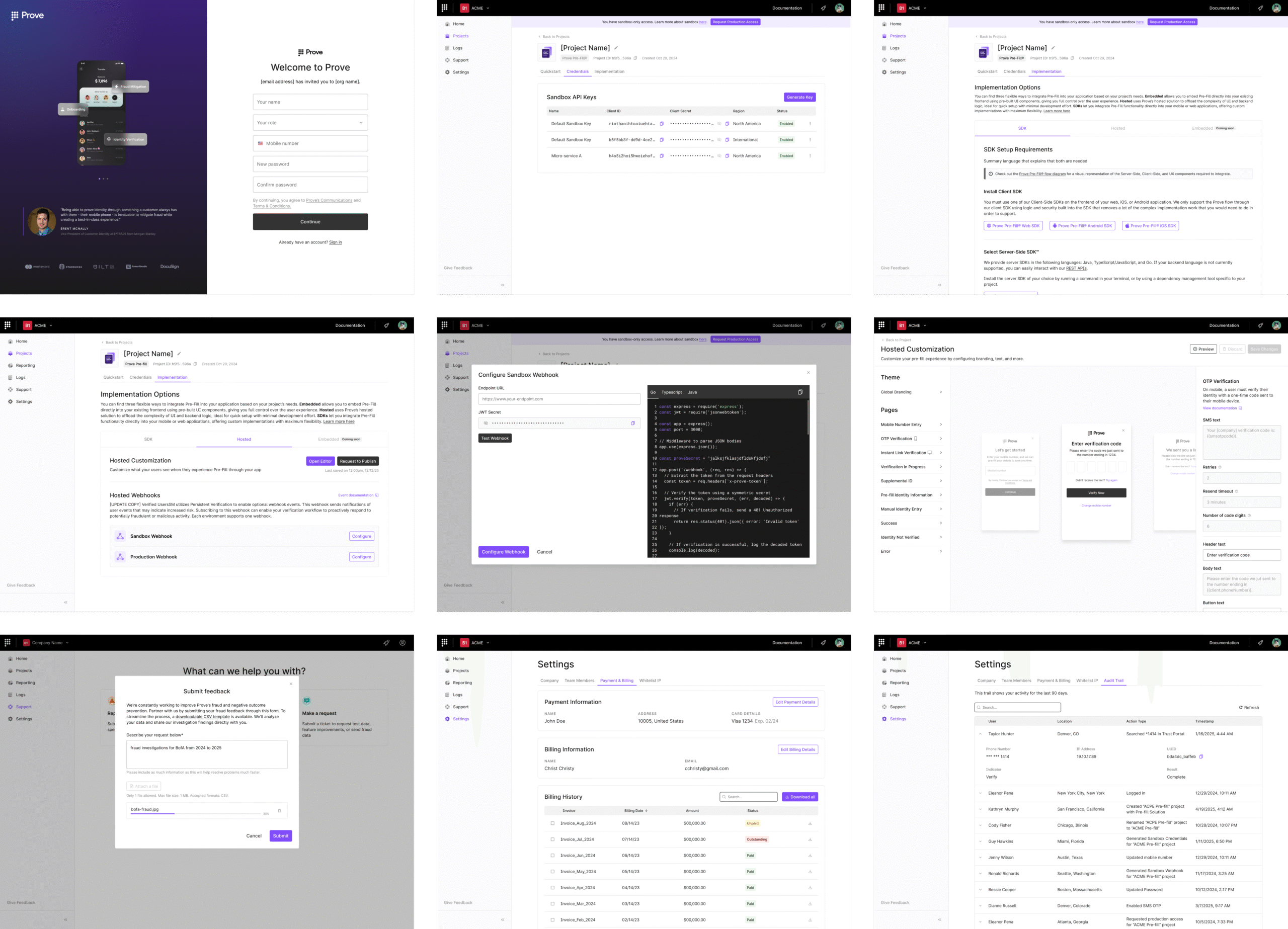
How I used design-driven discovery to guide our B2B pivot
Despite exciting early signals from Prove's improved APIs, it was clear we missed the mark for supporting the main users of Prove's products – the engineers. Our customer's Legal, Compliance, and Onboarding teams were happy with our API products and the results they had delivered, but the implementation process would take 6-7 months which resulted in lowered projected ARR for Prove. Over six weeks, I led the process to identify alternative paths forward, design a beta product we could put into market, and helped define a B2B strategy that led to the next evolution of Prove's products and how we speak to customers.
Impact
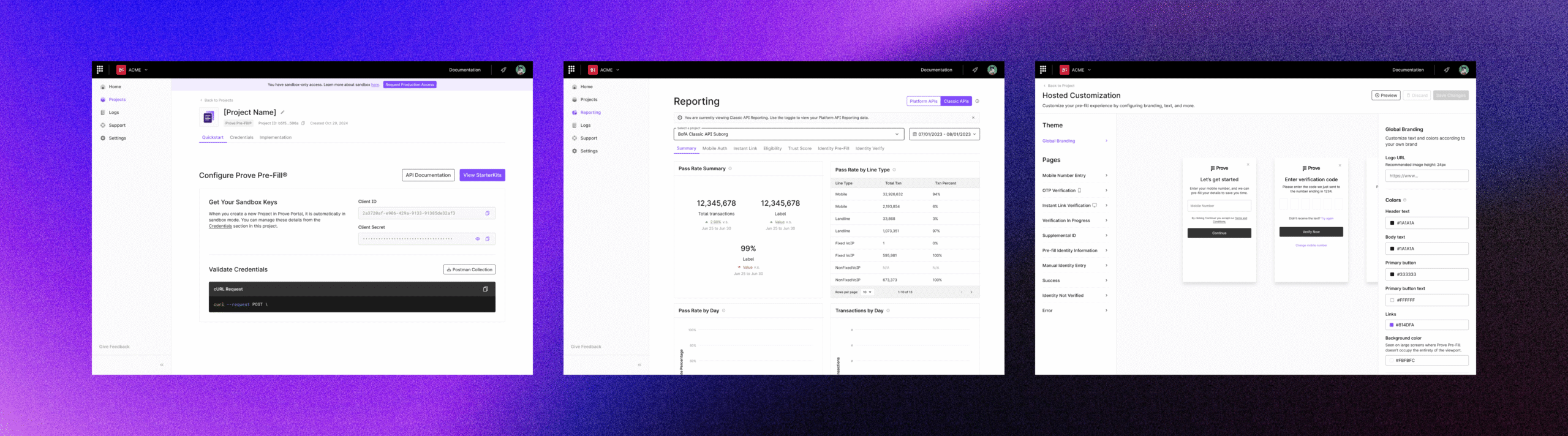
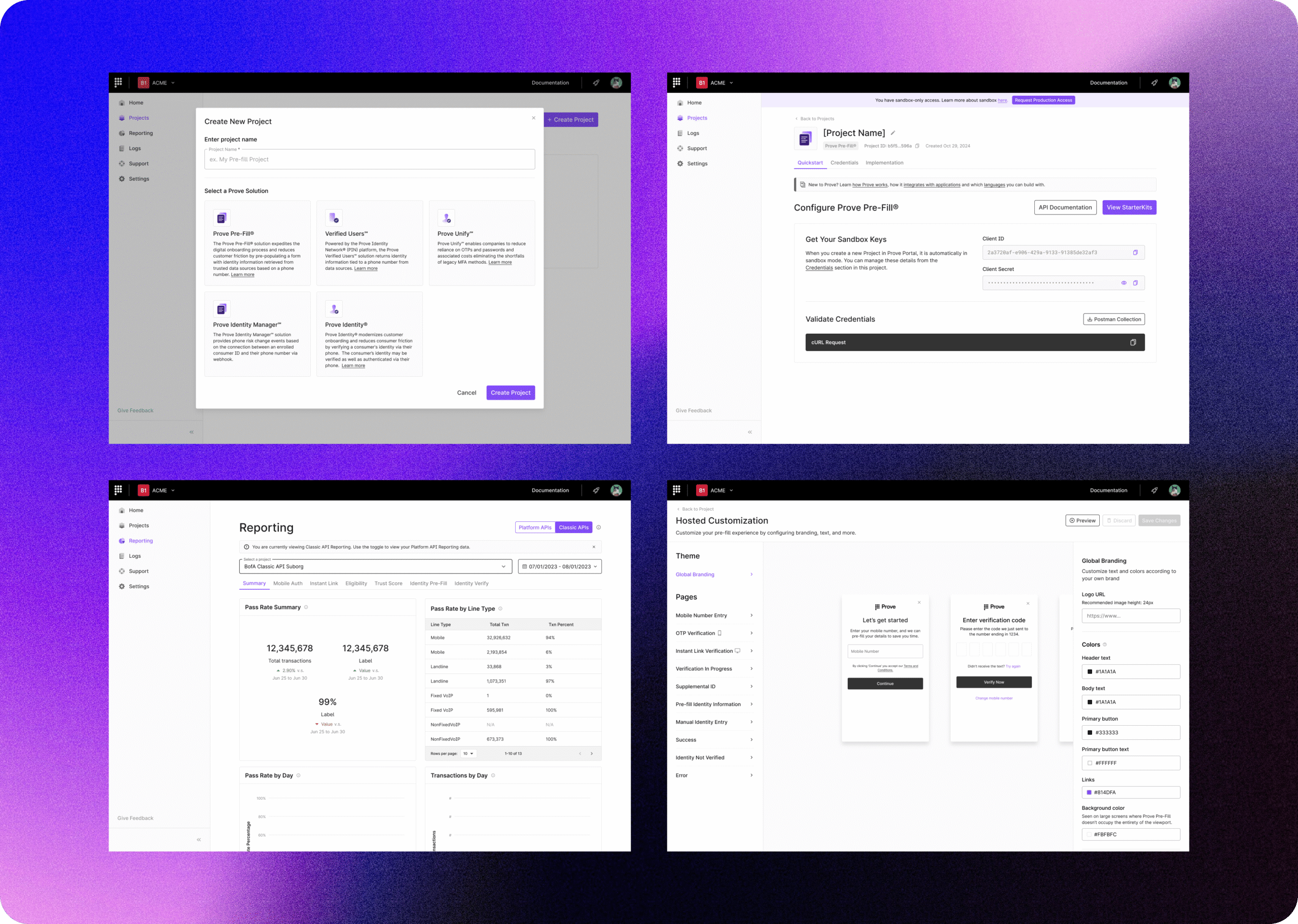
As a result of my work, the company introducted Prove Portal to our customers, reducing implementation time from 6 months to 2 weeks, increasing retention in its core journeys and decreasing customer support costs. I helped create a supporting product that solved for credentialing, implementation needs and for admin users.
Role
Product vision, research, product discovery, conceptual design, content design
Team
Portal Engineering Team, CTO, CRO, CPO
Where we started
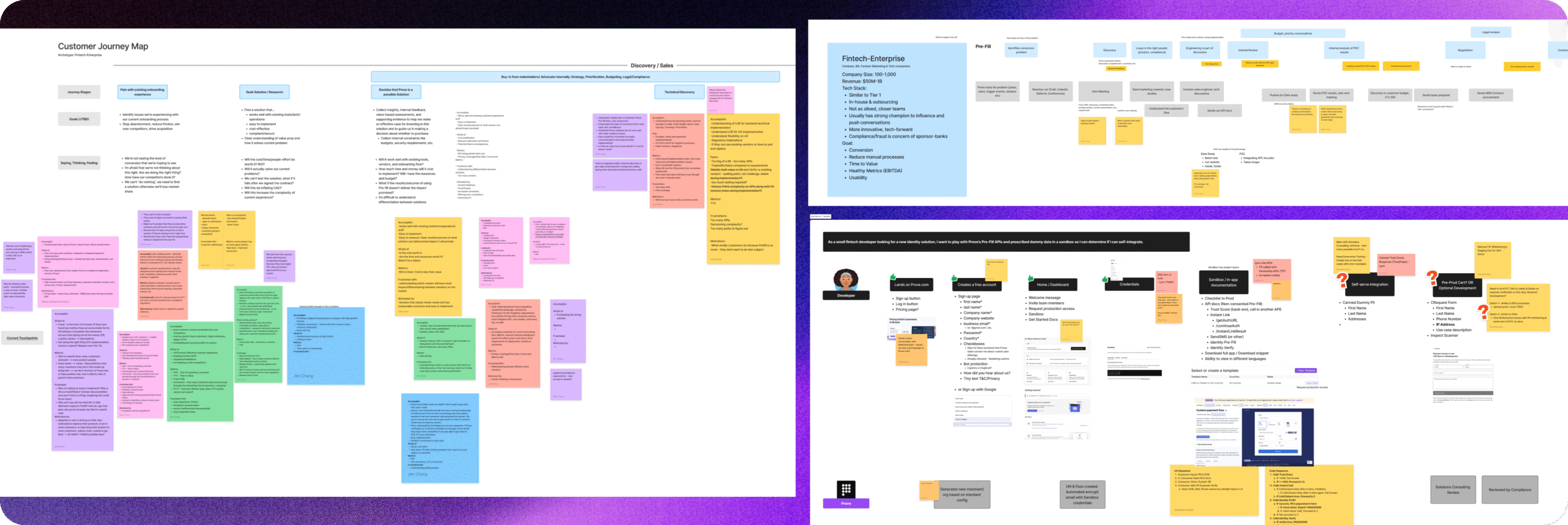
Although Product & Engineering teams had revamped how our APIs worked, Sales & Implementation teams were unaware of how it would improve their own workflows. I needed to have people from across the company involved. To make the most of everyone's time, I assembled 5 cross-functional teams, each tasked with gaining a deeper understanding of the experience of a specific phase along the full customer experience.
Prove is a fully remote team, so I gathered each squad for a 90-minute workshop in which we mapped our understanding of the experience today, grouped key themes of touchpoint, pain points, opportunities, and specific anecdotes we have heard directly from customers to help us understand what they are thinking or feeling at any given time.
I intentionally let this be a messy, generative process, staying firmly in the role of facilitator. Each squad took things in a slightly different direction, but the result was a broad set of data points that could be simplified into our current best assumption about a customer's experience interacting with us from the moment we hit their radar until renewal.
Running rapid prototyping
After running analysis and gathering pockets of opportunity, a small strike team gathered, and I facilitated a brainstorming session to generate a new vision for a Prove Portal application. Our hypothesis was to give the people implementing our APIs the ability to rapidly read, implement, and test the products in their sandbox while their Sales, Legal, and Compliance teams were in the contracting process with Prove.
Armed with these ideas, I rapidly generated a conceptual prototype to match our hypothetical experience and started to set up discovery calls. We sourced 15 people who identified as implementation specialists, who self-identified as having a responsibility in implementing front-end, back-end, and running test data for APIs.
As we learned from each conversation, I began to incrementally whittle down the large prototype into smaller pieces that could be individually assessed.
Results
As a result of the product discovery effort I led, our company successfully delivered a B2B portal that enabled engineers to implement rapidly, reducing implementation time from 6 months to 2 weeks, increased accuracy of ARR estimation, and increased customer satisfaction.
Because this was the first time Prove has delivered a custsomer-facing product, I was also responsible for establishing a shareable and reusable Design System. Working closing with our engineering team, we developed the Design System with StorybookUI, making the library usable across several internal engineering teams.